

You're staring at your exam prep checklist, and a question keeps nagging you: Should I solve more mock tests or focus on previous year papers? It's a dilemma every competitive exam aspirant faces, and honestly, both matter. But when and how you use them can make all the difference between an average score and a rank that opens doors.
If you're preparing for SSC, NEET, UPSC, or JEE, this question becomes even more crucial. Whether you're part of a competitive exam coaching centre or studying independently, understanding the role of each will transform your preparation strategy.
What Are Previous Year Papers (PYPs)?
Previous year papers are actual question sets that have appeared in past exams. They're like a window into the examiner's mind — they show patterns, favourite topics, and recurring question styles.
Why PYPs Build Your Foundation
When you solve PYQs, you're not just practising random questions. You're learning how the exam setter thinks. If a topic has been asked five times in the last ten years, chances are it'll appear again. This pattern recognition is gold.
PYPs also reduce anxiety. Many students feel overwhelmed by the unknown. Once you've solved past papers, the exam format stops being mysterious. You know what to expect.
The Limitation of Previous Year Papers
Here's the catch: PYPs reflect the past, not the future. Exam patterns change. Syllabus updates happen. New question types emerge. If you only practise PYQs, you might miss questions that follow a different pattern or use updated concepts.
Also, PYPs are limited in number. For many competitive exams, you'll exhaust them within weeks. Then what?
What Are Mock Tests?
Mock tests are practice exams designed to simulate the real exam as closely as possible. They're timed, follow the latest pattern, and include new questions based on the current syllabus.
Why Mock Tests Build Speed and Stamina
Here's where mocks excel: they replicate exam pressure. You sit for three hours under time constraints, just like on the real test day. Your heart races. Your hand cramps. Your mind gets tired.
Solving questions at home is different from solving them in exam conditions. Mocks teach you time management in a way nothing else can. They reveal where you lose marks — silly mistakes, slow sections, or weak topics.
The Detailed Performance Analysis
Most mock tests come with comprehensive performance reports. You'll see your accuracy percentage, time spent per question, comparison with other candidates, and subject-wise breakdowns. This data-driven feedback is invaluable for targeted revision.
The Catch with Mock Tests
Mock tests sometimes feel harder than the actual exam. If you score low, it can mess with your confidence. But here's the truth: a harder mock is your friend. It exposes gaps before the real exam.
Another issue: if mocks aren't designed well, they might not match the actual exam pattern. That's why choosing quality matters.
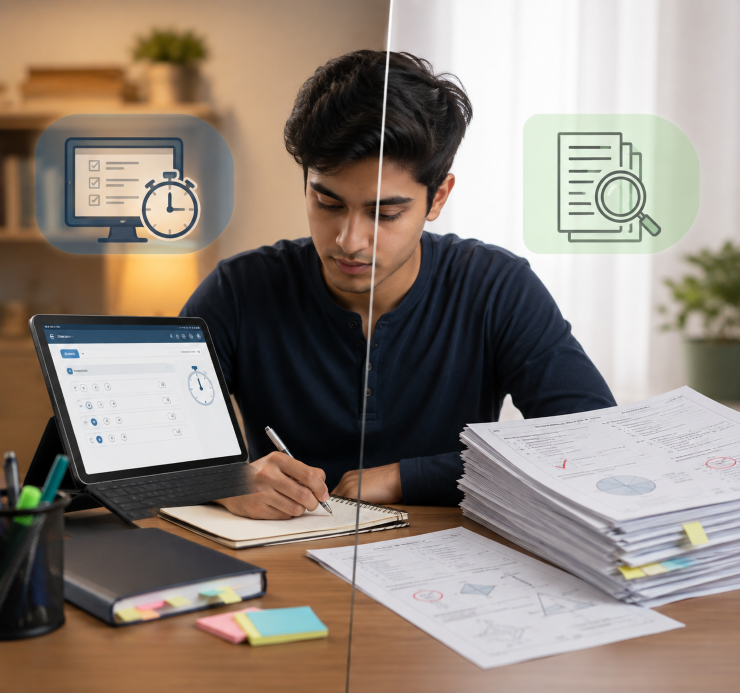
The Smart Strategy: Use Both, Not Either
The answer isn't "choose one." It's "use both at different times."
Phase 1: Foundation Building (Months 1–2)
Start with previous year papers. Solve them without time pressure. Your goal is understanding patterns, learning how questions are framed, and identifying frequently asked topics.
Read the solutions carefully. Don't just check if you're right or wrong — understand why that's the answer. This is where conceptual clarity builds.
Phase 2: Speed and Accuracy (Months 2–3)
Now switch to mock tests. Attempt 2–3 mocks every week. Each time, follow strict time limits. Analyse your performance ruthlessly.
Which sections drain your time? Where do careless errors happen? Are you skipping easier questions to chase harder ones?
Phase 3: Final Polish (Last 4–6 weeks)
This is when you balance both. Take mocks to maintain exam-day readiness, but revisit PYQs in areas where you're weak. If logic and reasoning trips you up, go back to past papers in that section.
If you're part of competitive coaching in Hoshiarpur, Dasuya, or Jalandhar, your institute likely provides structured mocks. Use those, but combine them with PYQs for a complete picture.
Common Mistakes Students Make
Mistake 1: Only Solving PYQs and Skipping Mocks
Some students think solving 10 years of past papers is enough. They never experience exam pressure until exam day. Result? Time management collapses, and they leave questions unanswered.
Mistake 2: Relying Entirely on Mocks Without Understanding Patterns
Others take mock after mock but never analyse trends. They don't notice that one topic appears every year. They treat each mock as isolated practice instead of learning from patterns.
Mistake 3: Not Reviewing Solutions
Attempting 50 mocks without reviewing them is pointless. The real learning happens during review — understanding where logic broke down, why you misread a question, or why your calculation was off.
The Final Verdict
PYQs show you what the exam expects. Mock tests train you how to deliver it. Use one without the other, and your preparation will always have a blind spot.
Start with patterns, end with pressure — that's the formula toppers swear by.
If you're ready to stop guessing and start ranking, VCANXL brings both worlds together — structured mock test series, PYQ-based learning, and expert mentorship through competitive exam coaching online and offline centres in Hoshiarpur, Dasuya, and Jalandhar.
Your rank is waiting. Come claim it.
FAQs
Q1: How many previous year papers should I solve?
Solve all available PYQs at least once. For competitive exam coaching centre aspirants, most institutes provide chapter-wise PYQ books. Start with topic-wise PYQs during learning, then solve full papers as exam approaches.
Q2: Are mock tests harder than the actual exam?
Sometimes, yes. Quality mock tests are often designed slightly harder to build your confidence. Scoring 75 percent in a challenging mock means you're likely to score higher in the actual exam. Don't panic if a mock score feels low — use it as fuel to improve.
Q3: Should I take mocks before finishing the entire syllabus?
No. Complete your syllabus first, then start mocks. Attempting mocks before learning all topics will only frustrate you. However, once you've covered a section, take sectional mocks to assess that area.
Q4: How many mock tests should I take before the exam?
Aim for at least 15–20 full-length mocks during your preparation. In the final month, take 2–3 every week. Quality matters more than quantity — one well-designed mock beats five poorly made ones.
Q5: Can I crack competitive exams with only online coaching and mock tests, without previous year papers?
Theoretically, yes, but it's risky. Mock tests follow patterns, but previous year papers show actual patterns from the exam board. Combining both ensures you're prepared for both predictable patterns and surprises.