

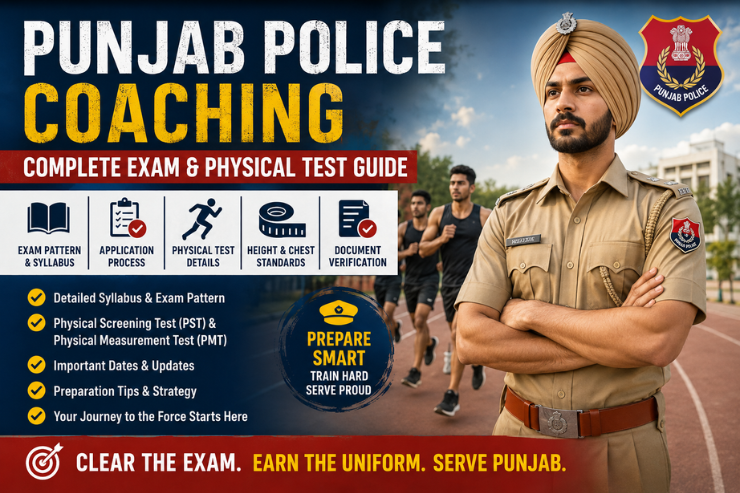
Every year, thousands of young men and women in Punjab apply for the Punjab Police Constable exam. Most of them prepare the same way - a few YouTube videos, some old notes from a friend, and a vague idea of "I'll run more before the physical test."
That is not preparation. That is hope.
The Punjab Police selection process is structured, predictable, and entirely learnable once you understand how it actually works. This guide breaks down everything - the syllabus, the physical test, the application process, and exactly how to become a Punjab Police officer, so you walk in prepared, not guessing.
How to Become a Punjab Police Officer?
Before the syllabus, before the physical test, you need to know the route itself.
To become a Punjab Police officer, you need to clear three stages in order - the written exam, the physical tests, and document verification. Miss one, and you do not move to the next, regardless of how strong you are at the others.
- Educational qualification: 10+2 from a recognised board, with Punjabi as a compulsory or elective subject, and a minimum of 60% marks for General category (50% for SC/ST/BC).
- Age limit: 18 to 28 years, with relaxation as per government rules.
- Selection stages: Computer-Based Test (CBT), Physical Screening Test (PST) and Physical Measurement Test (PMT), and Document Verification.
This is the same basic path whether you are applying from Jalandhar, Dasuya, Hoshiarpur, or anywhere else in the state.
Punjab Police Exam Syllabus: What You Actually Need to Study
This is where most candidates either win or waste months. The Punjab Police Constable exam syllabus is split across two papers, and they test very different things.
Paper 1: Main Scoring Paper
- General Awareness: Punjab-specific GK, current affairs, history, and governance
- Quantitative Aptitude: basic mathematics, percentages, ratios, and arithmetic
- Reasoning Ability: logical reasoning and analytical thinking
- English Language
- Digital and IT Literacy
This paper is 100 marks, 100 MCQs, and counts directly toward your final merit.
Paper 2: Punjabi Qualifying Paper
- Punjabi grammar, comprehension, and translation
- Tested at matric level
This paper is qualifying in nature. You need a minimum of 50% to pass, but the marks themselves do not add to your merit list. Here is the catch most people miss: fail Paper 2, and your strong Paper 1 score means nothing. You are disqualified regardless of how well you did otherwise.
There is no negative marking in either paper, which means attempting every question is always the smarter move.
Punjab Police Physical Test Date and What to Expect
Once you clear the written exam, you move to the physical stage and this is where fitness, not just study hours, decides your future.
The physical test has two parts:
- Physical Screening Test (PST): Running, long jump, and other fitness events, different for male and female candidates.
- Physical Measurement Test (PMT): Height and chest measurements checked against the minimum standard.
Minimum standards to know:
- Height: 5 feet 7 inches for male candidates, 5 feet 2 inches for female candidates
- Chest expansion: minimum 5 cm expansion required for male candidates
The exact Punjab Police physical test date and Punjab Police test date for the written exam are announced separately on the official portal after the application window closes, so check the official site regularly once you have applied, these dates are not negotiable, and missing them means waiting for the next cycle.
A word of advice that genuinely matters here: do not start your physical preparation after clearing the written exam. Start it now, alongside your study schedule. The PST and PMT are qualifying only - no marks, just pass or fail, and showing up unprepared has ended more careers than a tough written paper ever has.
How to Apply in Punjab Police: Step by Step
The Punjab Police application process is entirely online, and getting the basics right the first time saves you from rejected applications later.
- Visit the official Punjab Police recruitment portal and find the active recruitment notification.
- Register with your basic details: name, date of birth, email, and mobile number.
- Log in using your registration ID and complete the full application form.
- Upload a recent passport-size photo and signature as per the specified format.
- Pay the application fee online: refunds are not issued once paid, so double-check everything first.
- Download and save your confirmation and application form for future reference.
Keep your educational certificates, category certificate (if applicable), and a valid photo ID ready before you start, having these on hand makes the process far smoother.
Why Structured Guidance Matters For Punjab Police Coaching
A lot of candidates ask the same question every year. Can I clear this exam through self-study alone? You genuinely can. But here's what a good Punjab Police coaching centre actually adds that most self-study plans miss:
- A clear, topic-wise breakdown of the syllabus so you are not guessing what to prioritise
- Regular mock tests that mirror the actual CBT format and difficulty
- Structured physical training guidance alongside academic preparation
- Feedback on where exactly you are losing marks, not just how many you got
The written exam and the physical test are not separate races. Candidates who train for both together, on a structured timeline, consistently outperform those who treat them as two unrelated challenges tackled one after the other.
Your Journey to the Force Starts Here
Becoming a Punjab Police officer is not about luck or last-minute cramming. It is about understanding the process clearly and preparing for the written exam and the physical test side by side, right from day one. With the right guidance and a structured plan, every stage of this journey becomes far more manageable than it looks on paper.
If you are serious about clearing the Punjab Police exam this cycle, VCANXL's structured coaching covers exactly this: syllabus clarity, regular mock tests, and physical training guidance, all under one roof.
Frequently Asked Questions
Q1. What is the Punjab Police helpline number in Jalandhar? For the most accurate and updated helpline details specific to Jalandhar, always refer to the official Punjab Police recruitment portal or your nearest Punjab Police district office, as helpline numbers are updated with each new recruitment cycle.
Q2. How long does the entire Punjab Police joining process take? From application to final joining, the process typically takes a few months. It depends on the exam schedule, physical test dates, document verification timelines, and medical examination, all of which are announced progressively after the written exam.
Q3. Is Punjabi compulsory for the Punjab Police exam? Yes. Punjabi is tested in both Paper 1 and Paper 2, and you must have studied Punjabi at the matriculation level to be eligible to apply.
Q4. Is there negative marking in the Punjab Police written exam? No. There is no negative marking in either Paper 1 or Paper 2, so attempting every question, even ones you are unsure about, only works in your favour.
Q5. What happens if I clear the written exam but fail the physical test? The PST and PMT are qualifying stages. If you do not meet the required standards, you cannot move forward to document verification, regardless of how well you scored in the written exam. This is exactly why physical preparation needs to start early, not after the result.